Contents
-
Tags
Afghanistan America American Indians Archeology Art Beaches Berlin Bicycles Books China Cities Clothes Coney Island Design Detroit Drawing Exhibitions France Germany Governor's Island Harlem Human Rights Iran Japan Life Photo Archive Magnum Photos Music Nature New York Outer Space Painting Paris Performance Art Photography Quotations RIP Style Subway Tibet Years Ago YouTube
-
Archives
Blogroll
-
RSS Feeds
-
Meta
Static
RIP Tsutomu Yamaguchi
On Aug. 6, 1945, while visiting the city of Hiroshima on behalf of his employer, Mitsubishi Heavy Industries, Tsutomu Yamaguchi sustained serious burns when an American B-29 bomber named the Enola Gay dropped the world’s first atomic weapon. Yamaguchi managed to pass the first night in a shelter and then, made his painful way back to his hometown. Yamaguchi covered the intervening distance of 180 miles in a journey of about two days. In Nagasaki he received treatment for his wounds and, despite being heavily bandaged, he reported for work the next morning, August 9th. As Yamaguchi was describing the atomic blast to his supervisor, a second B-29 bomber named the Bocks Car dropped a larger atomic bomb on his hometown of Nagasaki. He is the only person officially recognized having survived both atomic bombings in Japan. He died of stomach cancer today at age 93.
Early American

“Still Life With Flowering Tobacco, 2009″

“Watermelon and Blackberries, 2009″
In order to create her Peale-inspired still lifes, Sharon Core photographs fruit grown in her own garden in the Hudson Valley and authentic period porcelain and tableware.
Early American
November 11December 11, 2009
Gallery at Hermés, New York
Wiltshire’s New York
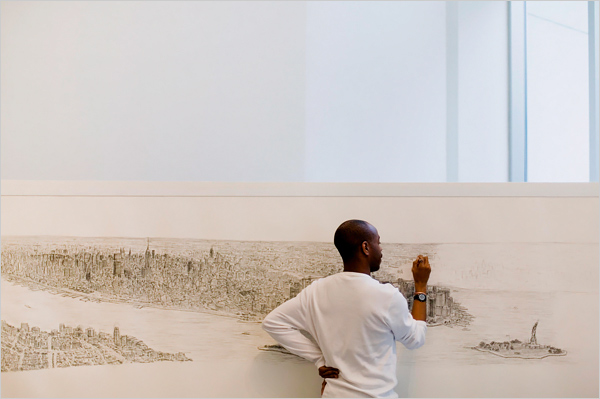
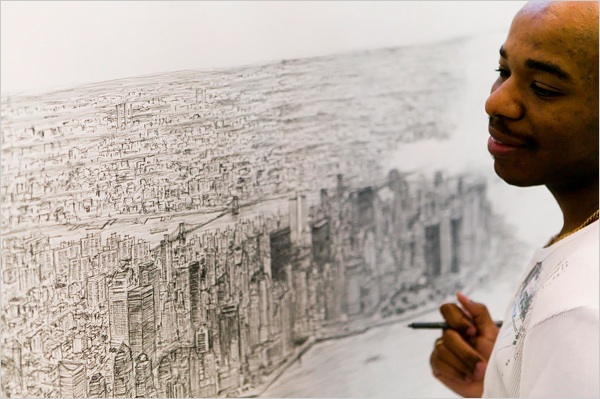
Stephen Wiltshire of London is drawing a panorama of New York City from memory. Wiltshire, who has autism, took a 20-minute ride over the city in a helicopter last Friday. Wiltshire has drawn panoramas of eight cities: Tokyo, Rome, Hong Kong, Frankfurt, Madrid, Dubai, Jerusalem, and London. The New York panorama will be his ninth and last.
The public will be able to visit Wiltshire while he works on his New York panorama from 10am to 5pm, Monday, October 26 to Friday, October 30 at the Pratt Institute’s Juliana Curran Terian Design Center.
Like a Skyline Is Etched in His Head, New York Times
Camouflage
The 36-year-old Liu Bolin paints on himself to blend into his surroundings. Liu poses and works for up to 10 hours at a time on a single photo. Sometimes passerbys don’t even realize he is there until he moves.
Liu sees his work as a silent protest against the Government’s persecution of artists. The Chinese authorities shut down his studio in 2005.
The Gao Brothers

The Gao brothers and “Mao’s Guilt”
In China, a Headless Mao Is a Game of Cat and Mouse, New York Times
The Americans
Goverthing
An odd excavation site has recently opened to the public on Governors Island purports to offer artifacts of an unusually modern variety, from about 1954.
That is the year, at least according to Geert Hautekiet, the man in charge of exhibiting the site, that the United States Army ordered an obscure civilian community there to be evacuated. The military then buried the town, known as Goverthing, under sand and denied that it had ever existed.
The Archeological Dig
Governor’s Island
September 10—October 11, 2009
Lost Lhasa

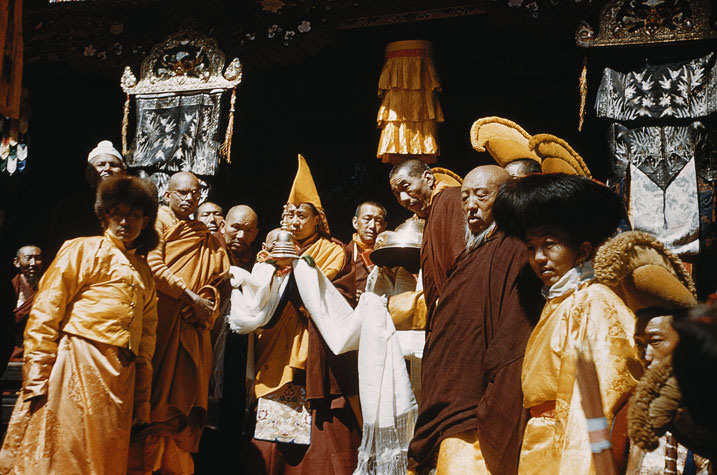
Cheeks ballooning, monks force sirenlike blasts from silver trumpets as they clear the way for their king.

Top Tibetan officials marvel at a souvenir from America. A finance secretary peers through a slide viewer, memento of a Tibetan trade delegation’s mission to the United States in 1948.

Mother and child pray on Chagpori’s crest, a pilgrim shrine.

Clouds of dust and incense veil the Dalai Lama’s flight to safety. When China’s troops entered Tibet in 1950, the Living Buddha fled to the Sikkim border. Here in a sedan chair, he rides between rows of stones designed to ward off demons.

In sublime reverence, the Dalai Lama cradles his faith’s holiest relic. When this young man was two years old, mysterious signs revealed him as the incarnation of Tibet’s patron god, Chanrezi, and the previous 13 Dalai Lamas. Here at Dungkhar Monastery he receives a gold-encased bone which Tibetans believe to be that of Gautama Buddha, who founded the religion on which Lamaism is based.
My Life in Forbidden Lhasa by Heinrich Harrer, National Geographic
The Snakehead
Several hours before dawn on June 6, 1993, two Park Service police officers were patrolling the road next to Jacob Riis Park, a long stretch of beach on the Rockaway peninsula, in Queens, when they were startled by two Asian men flagging them down. As the officers got out of their car, they heard the sound of screams coming from the beach. The moon was full, and about a hundred yards offshore the officers saw a hundred-and-fifty-foot tramp steamer that had run aground. The ship’s deck was crowded with people, and, as the officers watched, men and women jumped over the side, falling twenty feet into the surging waves below. Dozens of figures bobbed in the water, some managing to clamber ashore, others flailing wildly, apparently unable to swim. The officers radioed for backup.
The ship’s name, stencilled in white block letters on the bow, was the Golden Venture. Its cargo was nearly three hundred illegal Chinese emigrants. Before reaching the Rockaways, the ship had sailed some seventeen thousand miles, from Thailand to Kenya, around the Cape of Good Hope, then across the Atlantic to New York.
The Snakehead by Patrick Radden Keefe, The New Yorker
Afghanistan’s Hidden Treasures

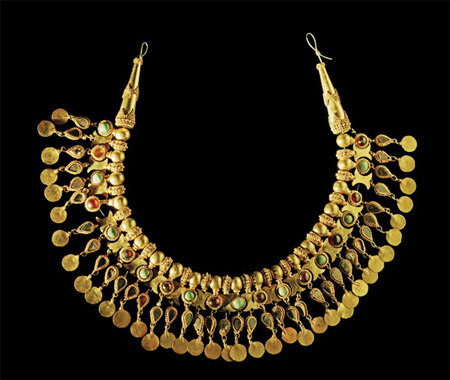
Gold necklace set with turquoise, garnet, and pyrite.

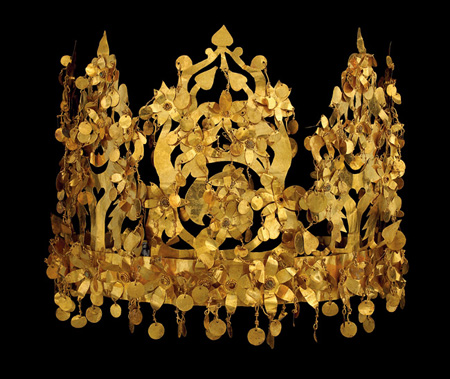
Folding gold crown. Could be laid flat and packed in a saddlebag when the tribe moved from place to place.
Omara Khan Massoudi knows how to keep a secret. Massoudi is director of the National Museum of Afghanistan in Kabul. Like the French citizens during World War II who hid works of art in the countryside to prevent them from falling into Nazi hands, Massoudi and a few trusted tahilwidars—key holders—secretly packed away Afghanistan’s ancient treasures when they saw their country descend into an earthly hell.
First came the Soviet invasion in 1979, followed about ten years later by a furious civil war that reduced much of Kabul to ruins. As Afghan warlords battled for control of the city, fighters pillaged the national museum, selling the choicest artifacts on the black market and using museum records to kindle campfires. In 1994 the building was shelled, destroying its roof and top floor. The final assault came in 2001, when teams of hammer-wielding Taliban zealots came to smash works of art they deemed idolatrous.
Afghanistan’s Hidden Treasures, National Geographic
Afghanistan: Hidden Treasures from the National Museum, Kabul
The Metropolitan Museum of Art
June 23—September 20, 2009
Waste Not
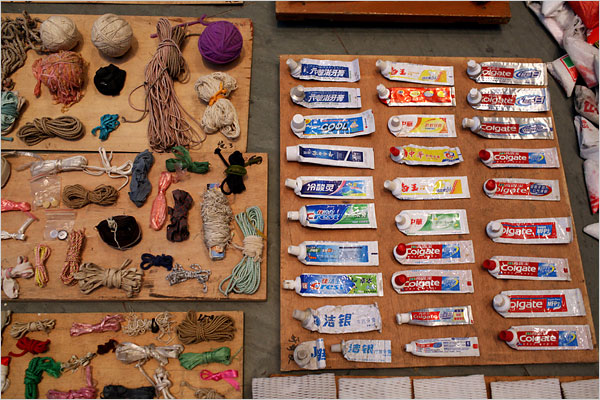
Purely to survive, Song Dong’s parents adhered to the Cultural Revolutionary dictum of frugality in daily life, with his mother carrying conservation to extravagant lengths.
The Collected Ingredients of a Beijing Life, New York Times
Waste Not
MoMA
June 24—September 7, 2009
65 Years Ago, Paris
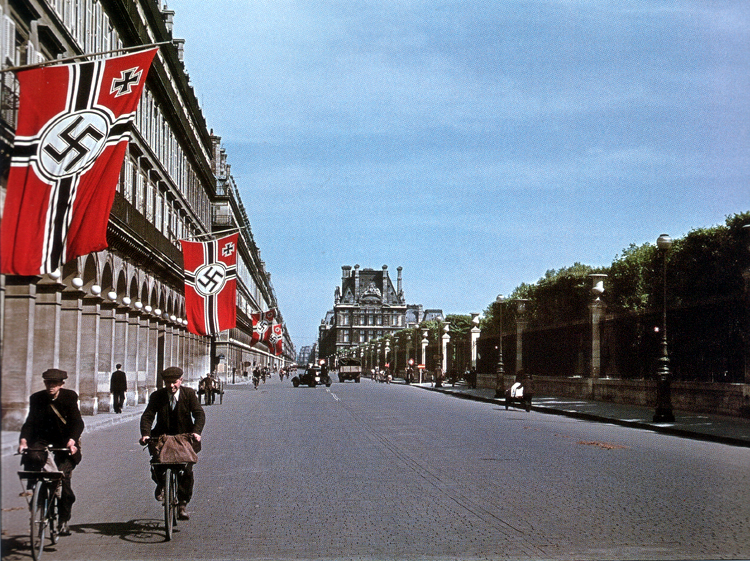
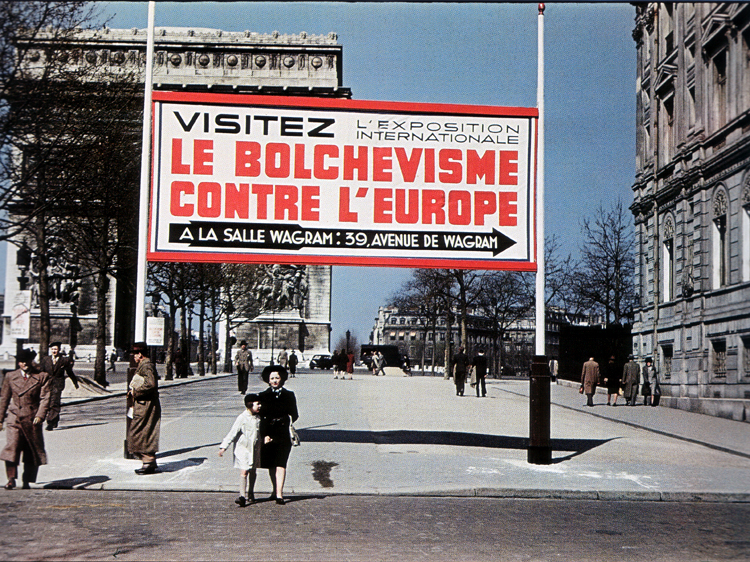
French photographer André Zucca was hired by the Nazi propaganda magazine Signal to capture scenes of Paris flourishing under German occupation. Joseph Goebbels decreed that the French capital should be “animated and gay” to show off the “new Europe.” Zucca was provided with rare Agfacolor film. His are the only known color photographs of occupied Paris.
After the liberation, Zucca was arrested but never prosecuted. He worked under an assumed name as a wedding photographer until his death in 1976.
Andre Zucca’s photographs of gay Paris at war paint an uneasy portrait of city collaboration, The Times (London)
LiveJournal: bekar
400 Years Ago, New York
“Gradually I became aware of the old island here that flowered once for Dutch sailors’ eyes—a fresh, green breast of the new world.” —F. Scott Fitzgerald, The Great Gatsby
Mannahatta/Manhattan: A Natural History of New York City
Museum of the City of New York
May 20October 12, 2009